The hard part was never how to execute.
It is which path, and when to move. And that is the one decision you cannot fully talk through with the people around you.
You know how to execute. You built the thing. What keeps a decision circling for months is rarely the work of doing it. It is knowing which direction is right, and whether now is the moment, while every room you might think it through in turns out to be the wrong one. Your team starts executing it. Your board hears risk. The person you go home to feels the weight.
This is the space for that decision. Not advice, not another opinion. A structured, protected place to think out loud, until the noise separates from the signal and the timing comes back into focus.
Book a ConsultationFree. No pitch. A first conversation.
Is this for you?
A particular kind of leader, at a particular kind of moment. Here is how to tell.

The company you built
- Most often 20 to 30 people, range 10 to 100
- Three to twelve million in revenue
- Yours from the start, still yours to run

The decision is yours
- Founder or CEO
- The direction is yours to set
- You can act on it, even where others weigh in

The crossroads
- The hard part is which path, and when, not how
- You can feel you are at a crossroads
- You are not looking to be talked into anything
Reading the shift
- You sense a shift before the data confirms it
- Others may think you are early
- You carry that read mostly alone
Only beginning to sense the shift? That is fine. This work is never too early, and that is often exactly the right moment to talk.
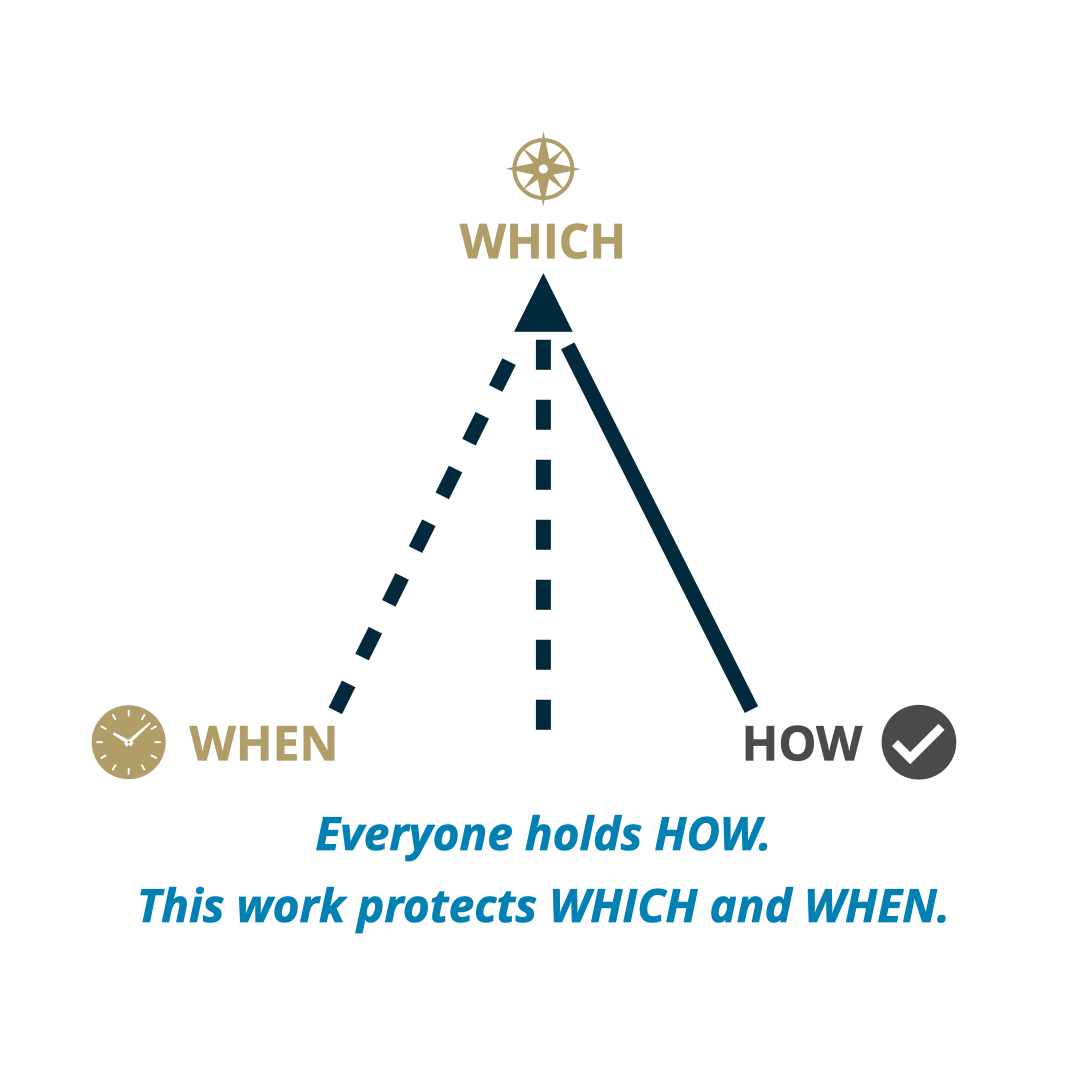
The Strategic Decision Triangle
Everyone helps you execute. The harder question is which path, and when.
Where the help usually goes
Almost everyone around you works on HOW. Your team, your operators, most advisors. Execution is the part you already have. The two corners that actually decide the outcome, which path and when to move, are the ones left to you.
The part left unattended
WHICH and WHEN are where directional decisions are won or lost. They are also the hardest to talk through, so they stay with you. Not because execution does not matter, but because it is already handled.
What this work protects
Protecting the two corners no one else is holding. Bringing structure to WHICH path and WHEN to move, so your own read of the situation becomes legible, and execution finally points in a direction you can stand behind.
What this work is not, and what it is

What it is not
Not coaching. Coaching asks you to do the sense-making yourself.
Not consulting. Consulting hands you a conclusion and a plan to execute.
Not a deck. You do not leave with someone else's recommendations to carry out.

What it is
A structured, protected space for one directional decision at a time.
A place to think out loud without performing confidence, where the noise separates from the signal and the timing comes back into focus.
You leave with a direction you can stand behind, and the reasoning to back it.
How working together unfolds
It usually begins with one conversation. Where it goes from there is up to you.

The first conversation
Where it begins
A quiet conversation to name the crossroads you are actually standing at, in your own words. No preparation, no pitch. You leave with a clearer sense of the decision, and of whether this is the right room for it.
Free. Around 20 minutes.

KAiROS™, the decision worked through
A single directional decision
When the decision needs more than one conversation, KAiROS™ gives it structure: which options are genuinely different, what you already know but have not been able to hear, which deadlines are real and which are manufactured pressure.
You work through which path and when to move, and you leave with a direction you can stand behind and the reasoning to back it.

Standing advisory
For the decisions that keep coming
For some leaders the single engagement is the whole of it. For others it becomes a standing arrangement: a steady room to bring the next directional decision, so you never have to carry one alone again.
Questions leaders often ask
Is this coaching, consulting, or something else?
Does it matter that you do not know my industry?
What about confidentiality?
What happens in the first conversation?
What if I am not sure it is a crossroads yet?
Do you work with companies outside this size?
Why systemic, not systematic?
Why not just use AI tools?
When you are ready, start with a conversation
You are not too early. And you do not have to carry the decision alone.
Not ready for that yet? There is a 15-minute research conversation among leaders who carry the same kind of decision. No pitch.
Join the research conversation
Never Too Early. Never Alone.